AI
How to assess AI readiness: seven data checks before an AI use case goes live
A practical way to assess whether your data is ready for a specific AI use case: seven checks covering the use case, data, access, quality, freshness, meaning and lineage, how to score them, and what to fix first.

Hemant Walchale
· 3 min read
Most AI pilots that stall do so for data reasons: the documents had no access rules, the metric meant three different things, the table was a week old. An AI readiness assessment finds those problems before launch. The key is to assess per use case, against seven concrete checks, instead of asking whether “the company” is ready for AI.
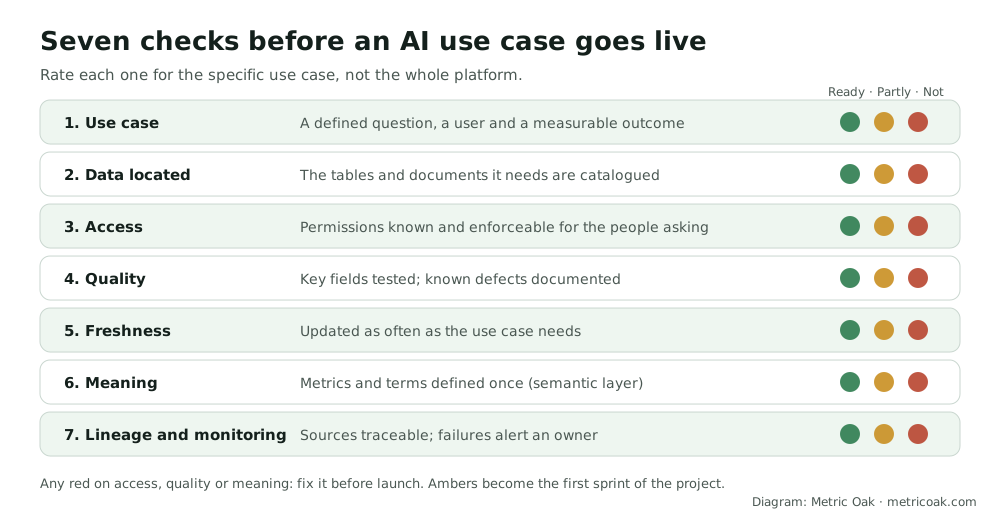
The seven checks
| # | Check | Ready when | Typical red flag |
|---|---|---|---|
| 1 | Use case | There is a defined question, a named user group and a measurable outcome | “Let’s see what AI can do with our data” |
| 2 | Data located | The tables and documents needed are known and catalogued | Key data sits in spreadsheets or a departed analyst’s notebook |
| 3 | Access | Permissions for the people who will ask are known and enforceable by the AI | The assistant would run on a shared service account |
| 4 | Quality | Key fields are tested, known defects documented | Duplicates and nulls are found by users, not tests |
| 5 | Freshness | Data is updated as often as the use case needs | A daily-decision assistant on weekly data |
| 6 | Meaning | Metrics and terms have one agreed definition | Finance and sales report different revenue |
| 7 | Lineage and monitoring | Sources are traceable and failures alert an owner | Nobody notices when a feed stops |
How to run it
- Pick one use case and write down its questions, users and success measure.
- List the data each question needs, down to tables, columns and document sets.
- Score each check ready, partly ready or not ready, with the data owners in the room. Evidence beats opinion: show the test results, the access rules, the last refresh time.
- Repeat for the next two or three use cases. Gaps that appear every time (for example no data quality tests, or no semantic layer) are platform investments, not project tasks.
What to fix first
- Any red on access blocks launch: an AI that answers from data the user should not see is a breach, not a bug. See AI agents on governed data.
- Any red on quality or meaning blocks launch: wrong answers delivered confidently destroy trust in weeks. See semantic layers for AI.
- Ambers become the first sprint of the project, with owners and dates.
- Freshness and monitoring can often improve in parallel, but agree the minimum before go-live.
A quick start
For a fast first view of your platform as a whole, take our free data platform scorecard; its AI readiness area uses the same principles. For an evidence-based assessment with a priced roadmap, see the Data Platform Assessment.
The short version
Assess AI readiness per use case against seven checks: use case, data located, access, quality, freshness, meaning, and lineage and monitoring. Treat red access, quality or meaning as launch blockers, turn ambers into the first sprint, and fund the gaps that repeat across use cases as platform work.
Related: what is data lineage, data contracts for data leaders and our AI-ready data service.
Further reading from other practitioners
Not sure where your own platform stands? Take the free 3-minute data platform scorecard. Unfamiliar terms are explained in the data engineering glossary.