Explainer
What is a data lakehouse? A plain-English explanation
A data lakehouse combines the low-cost, open storage of a data lake with the transactions, governance and fast SQL of a data warehouse. How it works, how it differs from a warehouse and a lake, and when it fits.

Hemant Walchale
· 4 min read
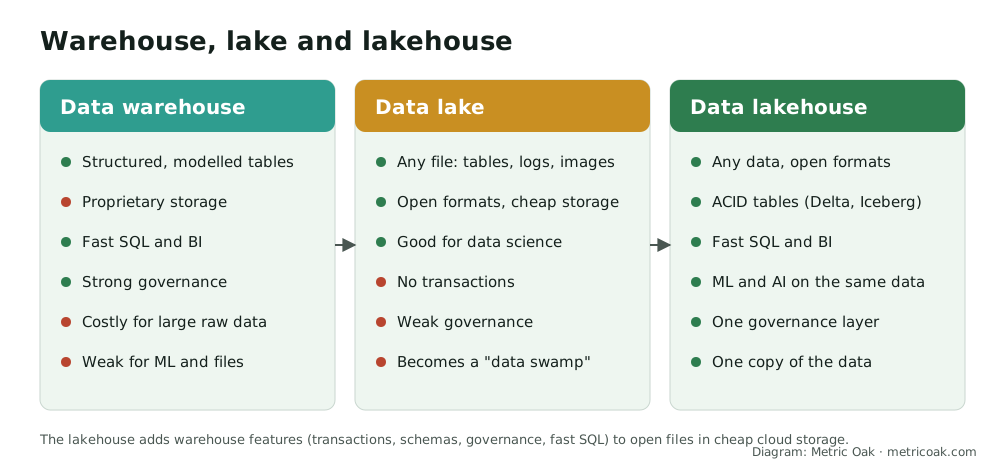
A data lakehouse is a data architecture that keeps all your data as open files in low-cost cloud storage, like a data lake, and adds the features that used to require a data warehouse: reliable transactions, enforced schemas, governance and fast SQL. The result is one copy of the data that reporting, data science and AI can all use.
Why the lakehouse appeared
For years, organizations ran two systems:
- A data warehouse for reporting: structured, governed and fast, but expensive for large volumes and poor at files, events and machine learning.
- A data lake for everything else: cheap storage for any file, popular with data scientists, but with no transactions, weak governance and a tendency to become a “data swamp”.
Data was copied from the lake to the warehouse, so teams paid for two copies, two pipelines and two sets of permissions, and the two often disagreed.
How a lakehouse works
The key ingredient is an open table format, such as Delta Lake, Apache Iceberg or Apache Hudi. It adds a transaction log on top of ordinary data files (usually Parquet) in cloud storage, which gives you:
- ACID transactions: writes succeed completely or not at all, so readers never see half-written data.
- Schema enforcement and evolution: bad records are rejected, and columns can be added safely.
- Time travel: query a table as it was at an earlier point.
- Fast queries: file statistics let engines skip data they do not need.
On top of that sit a governance layer (for example Unity Catalog on Databricks) and query engines for SQL, Python and machine learning, all reading the same tables.
Lakehouse, warehouse or lake?
| Data warehouse | Data lake | Data lakehouse | |
|---|---|---|---|
| Data types | Structured tables | Any file | Any file and tables |
| Storage format | Proprietary | Open | Open (Delta, Iceberg) |
| Transactions | Yes | No | Yes |
| SQL and BI performance | Strong | Weak | Strong |
| Machine learning and AI | Weak | Strong | Strong |
| Governance | Strong | Weak | Strong, in one layer |
| Copies of the data | One per system | One per system | One |
Where you will find lakehouses
- Databricks is built around the lakehouse, with Delta Lake and Unity Catalog.
- Microsoft Fabric stores all data as Delta tables in OneLake.
- Snowflake supports Apache Iceberg tables alongside its native tables.
- Google Cloud offers BigLake for open-format tables queried by BigQuery and other engines.
Most estates are organized into layers inside the lakehouse, commonly the medallion architecture.
When a lakehouse fits, and when it doesn’t
It fits when you have files, events or documents as well as tables, when data science or AI matter, when you want to stop copying data between systems, or when you want to keep data in open formats you control.
A warehouse may be simpler when your data is almost entirely structured and used only for reporting by SQL analysts.
The short version
A data lakehouse puts warehouse features (transactions, schemas, governance, fast SQL) on top of open files in cheap cloud storage, so reporting, data science and AI share one governed copy of the data.
Related: medallion architecture, Unity Catalog, and Databricks vs Snowflake. Moving to a lakehouse from a legacy warehouse? See our migration guides or the data engineering glossary.
Sources
- Lakehouse: a new generation of open platforms that unify data warehousing and advanced analytics, Armbrust et al., CIDR 2021 (the paper that defined the term)
- Delta Lake documentation and Apache Iceberg documentation
Not sure where your own platform stands? Take the free 3-minute data platform scorecard, or see how we work on Databricks. Unfamiliar terms are explained in the data engineering glossary.