Explainer
What is medallion architecture? Bronze, silver and gold explained
Medallion architecture organizes a lakehouse into bronze (raw), silver (cleaned and conformed) and gold (business-ready) layers. What each layer holds, rules that keep it working, common mistakes and how to build it.

Hemant Walchale
· 3 min read
Medallion architecture is a way of organizing data in a lakehouse into three layers of tables, named after medals: bronze for raw data, silver for cleaned and conformed data, and gold for business-ready data. Each layer is more refined than the one before, and quality checks sit between them.
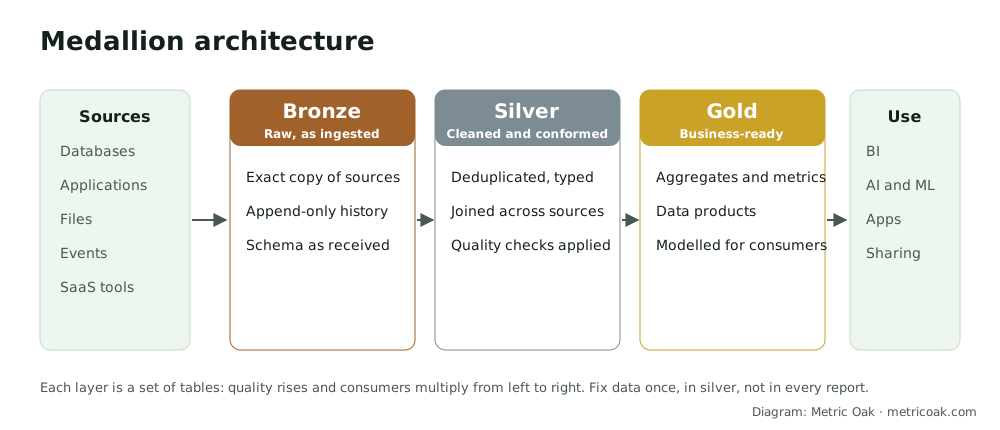
The three layers
Bronze: raw, as ingested
- An exact copy of what arrived from each source, with load metadata (source, time, batch).
- Usually append-only, keeping history so you can reprocess later.
- Minimal transformation: the schema is what the source sent.
Silver: cleaned and conformed
- Deduplicated, correctly typed, with consistent names and codes.
- Joined across sources into business entities such as customers, orders and products.
- Data quality checks applied: bad records are fixed, quarantined or rejected here.
Gold: business-ready
- Aggregates, metrics and dimensional models built for specific consumers.
- Data products with owners and documented definitions.
- What BI dashboards, AI and machine learning features, applications and data sharing read.
Rules that keep it working
- Keep bronze replayable. If silver logic changes, you should be able to rebuild it from bronze without going back to the sources.
- Fix data once, in silver. Quality fixes made in every report diverge; fixes made in silver are shared by everyone.
- Build gold for consumers. Each gold table should have a known audience and owner; gold tables nobody reads are cost without value.
- Put quality checks between layers, for example expectations in Lakeflow Declarative Pipelines or dbt tests.
- Govern every layer. Raw bronze data often contains sensitive fields; restrict access accordingly.
Common mistakes
- Too many layers. “Silver 2” and “gold staging” tables multiply cost and confusion. Add a layer only when it removes duplication.
- Business logic in bronze. It makes reprocessing impossible.
- Reports reading silver directly. They bypass the definitions in gold and drift apart.
- No ownership. Every silver and gold table needs a named owner.
How it is built
On Databricks, medallion layers are commonly built with Lakeflow Declarative Pipelines (streaming tables for bronze, materialized views and AUTO CDC for silver and gold) or with dbt, governed by Unity Catalog. The same pattern works on Snowflake (dbt, Dynamic Tables), Microsoft Fabric (Lakehouse and Warehouse) and BigQuery.
The short version
Medallion architecture separates raw (bronze), cleaned (silver) and business-ready (gold) data, with quality checks in between. Keep bronze replayable, fix data once in silver, build gold for named consumers and resist adding layers.
Related: what is a data lakehouse, change data capture, dbt vs Lakeflow Declarative Pipelines and the data engineering glossary.
Sources
- What is a medallion architecture?, Databricks glossary
- Lakeflow Declarative Pipelines, Databricks documentation
Not sure where your own platform stands? Take the free 3-minute data platform scorecard, or see how we work on Databricks. Unfamiliar terms are explained in the data engineering glossary.