Explainer
What is reverse ETL? How it works, use cases and pitfalls
Reverse ETL syncs modelled data from your warehouse or lakehouse back into operational tools such as CRM, marketing, support and finance systems. How it works, common use cases, tools, and the governance and reliability issues to plan for.

Hemant Walchale
· 3 min read
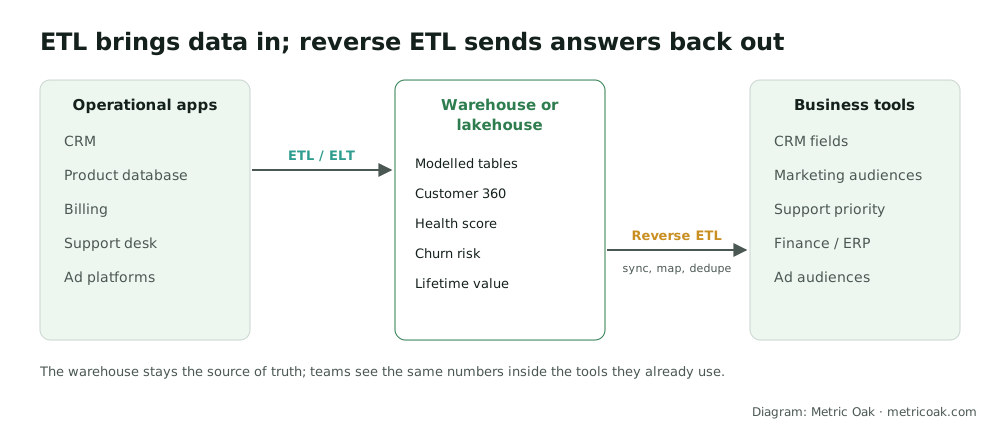
Analytics teams build valuable things in the warehouse: a single customer view, health scores, churn predictions, lifetime value. Then those numbers sit in dashboards while sales, marketing and support work in other tools. Reverse ETL closes that gap by syncing modelled data from the warehouse or lakehouse back into the operational tools where people act.
How it works
- Model in the warehouse. Build a table or view with one row per record to sync (for example per customer) and the fields to send.
- Map to the destination. Match warehouse columns to destination fields and choose the key that identifies the record (email, account ID).
- Sync changes. The tool compares the current result with what it last sent and pushes only inserts, updates and (optionally) deletes, on a schedule or triggered after the pipeline runs.
- Handle the API. Rate limits, batching, retries and per-record errors are managed by the sync and reported back.
Common use cases
| Team | What gets synced | Where |
|---|---|---|
| Sales and account management | Product usage, health score, expansion signals | CRM account and contact fields |
| Marketing | Segments, lifetime value, propensity scores | Email, marketing automation and ad audiences |
| Customer support | Customer value, plan, recent issues | Help desk, to prioritise tickets |
| Finance | Reconciled revenue, usage for billing | ERP and billing systems |
| Product | Feature flags or in-app messages by segment | Product and engagement tools |
Pitfalls to plan for
- The warehouse becomes production. Once a CRM field depends on a sync, a late or broken pipeline is a business outage. Monitor freshness and volume on synced models (see data observability) and alert their owners.
- Personal data and consent. Syncing personal data to marketing and ad platforms has to respect consent and data protection rules. Filter in the model, not in the destination.
- Who owns the field? If both the sync and users can edit a destination field, they will overwrite each other. Make synced fields read-only in the destination, or agree precedence.
- Definitions drift. “Active customer” must mean the same in the CRM as in the dashboard. Source synced metrics from a governed model or semantic layer.
- Build vs buy. A custom script for one destination is fine. Ten destinations with changing APIs is a product to maintain, which is where dedicated tools usually pay off.
The short version
Reverse ETL syncs modelled warehouse data, such as health scores and segments, into CRM, marketing, support and finance tools, so teams act on the same numbers analysts see. Treat synced models as production data: monitor them, govern personal data in the model, make synced fields read-only, and source metrics from governed definitions. Our data platform engineering team builds the models and pipelines behind reliable syncs.
Related: what is change data capture, what is medallion architecture, semantic layers for AI and what is data observability.
Sources
- Fivetran signs agreement to acquire Census, Fivetran press release, May 2025
Further reading from other practitioners
Not sure where your own platform stands? Take the free 3-minute data platform scorecard. Unfamiliar terms are explained in the data engineering glossary.